Welcome to The Montreal Resource and Training Center For Optimal Health and Entrepreneurship!
Our mission is to support anyone, regardless of age, gender, education or race, to take control of their professional lives by learning what it takes to become an entrepreneur.
All the services we offer are absolutely free.
These services include
- One on one coaching sessions on entrepreneurship
- One on one coaching sessions on optimal health and nutrition
- Extensive workshops on entrepreneurship
- Extensive workshops on optimal health and nutrition
- Access to learning material on entrepreneurship (Free references and consultation)
- Access to learning material on optimal health and nutrition (Free references and consultation)
- Advice on general finances
- A community of like-minded individuals who are ready to learn and achieve their goals
------------------------------------------------------------------------------------------------------
Today's Challenges
The challenges we face when it comes to health: Statistics Canada stated on March 31st 2009 that ''In 2005, the three leading causes of death in Canada were cancer, heart disease and stroke. These three causes of death were responsible for 58% of all deaths in Canada in 2005.'' http://www.statcan.gc.ca/daily-quotidien/090331/dq090331g-eng.htmStatistics Canada also released another report on March 18th 2009 stating ''Of all persons living in Canada on January 1, 2005, 695,000 had been diagnosed with an invasive cancer at some point in the previous 10 years. Some individuals experienced more than one invasive cancer over the 10-year period, with the number of cancer cases totalling 723,000.'' http://www.statcan.gc.ca/daily-quotidien/090318/dq090318b-eng.htm | The challenges we face when it comes to employment: Statistics Canada stated on May 8th 2009 that ''overall employment has fallen by 321,000 since the peak in October 2008. The unemployment rate was unchanged at 8.0% in April, remaining at its highest level in seven years, with the growth in employment coinciding with an increase in the labour force.'' http://www.statcan.gc.ca/subjects-sujets/labour-travail/lfs-epa/lfs-epa-eng.htm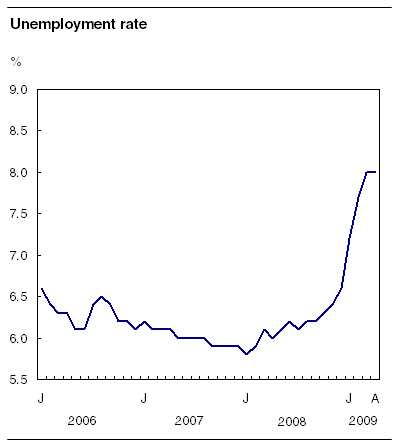 |
--------------------------------------------------------------------------------------------------------------------------
--------------------------------------------------------------------------------------------------------------------------
What can we do?
The first step in problem solving is problem definition (defining the problem you want to solve).
The second step is problem analysis (Understanding where the problem is coming from, how it fits in with current developments and what the current environment is, is crucial when working out whether a solution will actually work or not).
The third step is generating possible solutions (you should concentrate on generating many solutions and should not evaluate them at all). This is where the center comes in!
The fourth step is analyzing the solutions (you investigate the various factors about each of the potential solutions. You note down the good and bad points and other things which are relevant to each solution).
The fifth step is selecting the best solutions (evaluating the pros and cons of each solution and grading them).
The final step is planning the next course of action (you write down what you are going to do next. Decide how you will make the solution happen).
And of course taking action!
------------------------------------------------------------------------------------------------------
What do we know about the problem?
About degenerative diseases? According to The Canadian Cancer Statistics 2009, Part 6. Probability of Developing or Dying of cancer: ''Men have a lifetime probability of about 45% for developing cancer or a ratio of 1 in 2.2. This means that nearly one of every two men is expected to develop cancer during his life. Similarly, women have a nearly 40% chance of developing cancer in their lifetime, or sligthly more than 1 in 2,5 ratio. One in 3,5 men and 1 in 4,2 women, or approximately 1 in 4 of all Canadians will die of cancer.''Cancer Advocacy What are the causes of cancer? According to The Canadian Cancer Society, these are the main causes of cancer:
Canadian Cancer Society This is a trailer of Nos enfants nous accuseront explaining the corelation between the chemicals used in our conventional food and the rise of cancer in society. | About unemployment?
''Only half of all working Canadians have a single, full-time job that has lasted six months or more. The current Canadian labor force includes:
Precarious employment is a source of stress due to a lack of income and meaningful work, uncertain prospects for the future, and its potential to undermine social support networks (World Health Organization, 1999).'' http://www.phac-aspc.gc.ca/ph-sp/oi-ar/04_employment-eng.php 2. Job Loss is at a record high and will keep rising according to Toronto-Dominion Bank : ''Canada's unemployment rate will peak at 10% in early 2010 as Canada becomes an "unfortunate bystander" to a worsening U.S. recession, according to a forecast from Toronto-Dominion Bank on Thursday.'' "[This year] will go down in the history books as one of the most difficult economic years for Canadians," said Don Drummond, TD's chief economist.'' ''In all, 500,000 jobs will be purged from the Canadian economy in 2009, TD said. A 10% unemployment rate would be the highest since the end of 1996, when Canada was well on the way to recovery from the last recession.'' http://www.financialpost.com/story.html?id=1381137 3. Major layoffs took place and more are expected to take place in the future according to CBC:
|
It starts with you
Although times seem difficult at the moment, we have the potential of growing and becoming better human beings despite the challenges we face. That is the goal of this center; building strong leaders and entrepreneurs who will take charge of their lives and help teach others take charge of theirs. Together, we can grow as a healthier and wiser community and spread the vision of optimal health and entrepreneuship across Canada. We can't do it alone. It starts with you.
Contact us now to begin this journey:
Join our Facebook Group